

SEO vs SEM: What’s the Real Difference? A Complete Guide
Introduction: Why Understanding SEO and SEM Matters
In today’s digital world, search engines play a central role in how people discover information, products, and services online. Whether someone is searching for a solution to a problem, comparing products, or looking for a local service, the journey often begins with a search query. Because of this, businesses and website owners must focus on visibility in search results if they want to reach their target audience.
Two of the most important strategies used to achieve this visibility are Search Engine Optimization (SEO) and Search Engine Marketing (SEM). While these terms are frequently mentioned in digital marketing discussions, many beginners and even business owners often confuse them or assume they are the same thing.
Both SEO and SEM aim to increase a website’s presence in search engine results, but they do so in very different ways. SEO focuses on improving a website so it can appear naturally in organic search results. SEM, on the other hand, focuses on paid strategies that allow businesses to place advertisements within search results.
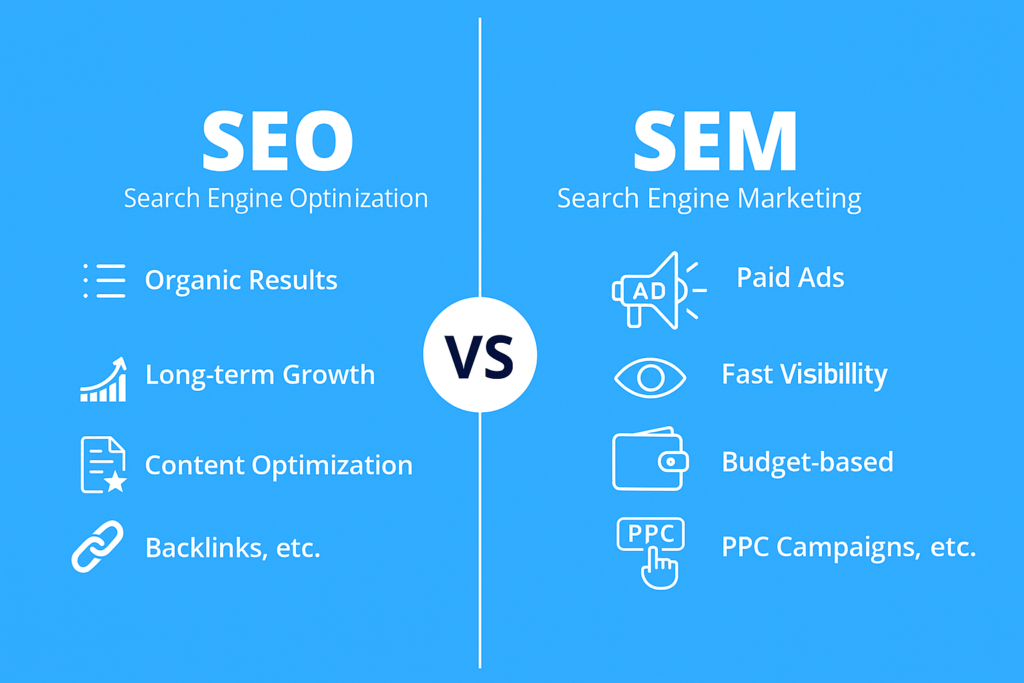
Understanding the difference between these two approaches is essential for anyone involved in digital marketing. Each strategy has its own advantages, limitations, costs, and best-use scenarios. In many cases, the most successful online marketing strategies use both methods together.
In this guide, we will explore the real difference between SEO and SEM, how each one works, their benefits and limitations, and how businesses can decide which approach is right for them.
What is SEO (Search Engine Optimization)?
Simple Definition of SEO
Search Engine Optimization, commonly known as SEO, is the process of improving a website so that it appears higher in organic search engine results. Organic results are the listings that appear naturally on a search engine results page without being paid advertisements.
The main goal of SEO is to increase the quality and quantity of website traffic by making the website more relevant, useful, and trustworthy in the eyes of search engines.
When a website is properly optimized, it becomes easier for search engines to understand its content and determine when it should appear in search results.
How SEO Works
Search engines use complex systems to discover and rank web pages. This process generally happens in three major steps:
Crawling
Search engines send automated programs, often called crawlers or bots, to explore the internet and discover new or updated web pages. These crawlers follow links from page to page, gathering information about the content they find.
Indexing
Once a page is discovered, the search engine analyzes its content and stores it in a large database known as an index. Only pages that are indexed can appear in search results.
Ranking
When a user performs a search, the search engine analyzes the query and retrieves the most relevant pages from its index. These pages are then ranked according to hundreds of factors, such as relevance, quality, usability, and authority.
The higher a website ranks in search results, the more likely it is to receive clicks and visitors.
Core Elements of SEO
SEO is generally divided into three main areas: on-page SEO, technical SEO, and off-page SEO.
On-Page SEO
On-page SEO focuses on optimizing the content and elements that appear directly on a website’s pages.
Important aspects include:
- Using relevant keywords that match what users are searching for
- Writing high-quality, helpful content
- Creating clear and descriptive titles and headings
- Optimizing meta descriptions
- Improving readability and structure
On-page SEO ensures that both users and search engines can easily understand the topic and purpose of each page.
Technical SEO
Technical SEO focuses on the underlying structure and performance of a website.
Key technical factors include:
- Fast page loading speed
- Mobile-friendly design
- Secure connections (HTTPS)
- Clear site architecture
- Proper indexing and crawlability
These elements help search engines access and understand a website more effectively.
Off-Page SEO
Off-page SEO refers to activities that happen outside the website but still influence search rankings.
The most important factor here is backlinks, which are links from other websites pointing to your content. When reputable websites link to a page, search engines interpret it as a sign that the content is trustworthy and valuable.
Other off-page factors include brand mentions, online reputation, and social signals.
Benefits of SEO
SEO offers several long-term advantages:
- It generates consistent organic traffic over time
- It builds trust and credibility with users
- It improves the overall user experience of a website
- It can provide long-lasting results even after the initial work is done
Because of these benefits, SEO is often considered a foundational part of digital marketing.
Limitations of SEO
Despite its advantages, SEO also has limitations:
- Results can take months to appear
- Competition can make ranking difficult
- Continuous updates and improvements are necessary
For businesses looking for immediate results, SEO alone may not always be enough.
What is SEM (Search Engine Marketing)?
Simple Definition of SEM
Search Engine Marketing (SEM) refers to the use of paid advertising to increase visibility in search engine results pages.
Instead of relying on organic rankings, SEM allows businesses to pay for advertisements that appear at the top or bottom of search results when users search for specific keywords.
These ads are designed to attract attention and encourage users to click through to a website.
How SEM Works
SEM works through a system where advertisers select keywords that are relevant to their products or services. When a user searches for those keywords, the search engine displays advertisements that match the query.
Advertisers typically compete for ad placement using a bidding system. However, the highest bid is not always the only factor that determines placement. Other elements such as ad relevance and landing page quality also play an important role.
The most common payment model used in SEM is pay-per-click (PPC). In this system, advertisers only pay when someone actually clicks on their ad.
Key Components of SEM
Keyword Targeting
The first step in SEM is identifying keywords that potential customers are likely to search for. These keywords should match the intent of users who are looking for specific products, services, or information.
Ad Creation
Once keywords are selected, advertisers create ads that appear in search results. These ads usually include:
- A headline
- A short description
- A display URL
- A call-to-action
Effective ad copy encourages users to click and learn more.
Landing Page Optimization
When someone clicks on an ad, they are directed to a landing page. This page must be relevant to the advertisement and designed to encourage a specific action, such as making a purchase, filling out a form, or signing up for a service.
Performance Tracking
One of the strengths of SEM is its ability to track performance in real time. Marketers can monitor metrics such as clicks, impressions, conversions, and return on investment.
These insights allow campaigns to be adjusted and optimized continuously.
Benefits of SEM
SEM offers several advantages for businesses that want quick visibility:
- Immediate presence in search results
- Fast traffic generation
- Highly targeted advertising
- Easy performance measurement
Because of its speed and flexibility, SEM is often used for product launches, promotions, or short-term campaigns.
Limitations of SEM
SEM also has several drawbacks:
- Traffic stops when advertising stops
- Costs can increase with competition
- Campaigns require constant monitoring and optimization
For these reasons, SEM is often used alongside other marketing strategies.
Organic vs Paid Traffic: The Core Difference
The most fundamental difference between SEO and SEM is the type of traffic they generate.
What is Organic Traffic?
Organic traffic refers to visitors who arrive at a website through unpaid search results. These users click on listings that appear naturally because the search engine considers them relevant and valuable.
Organic traffic is often associated with trust because users know the results were not paid for.
What is Paid Traffic?
Paid traffic comes from advertisements displayed within search results. These listings are clearly marked as sponsored or promoted content.
Advertisers pay for these placements and typically pay when someone clicks the ad.
Key Differences Between Organic and Paid Traffic
Several factors distinguish organic and paid traffic:
Speed of results
Paid advertising can generate traffic almost immediately, while SEO often requires time to build rankings.
Cost structure
Organic traffic does not require payment for each visitor, but it requires investment in optimization and content creation. Paid traffic requires ongoing advertising spending.
User trust
Many users tend to trust organic listings more because they are earned through relevance rather than payment.
Longevity
Organic rankings can continue bringing traffic long after content is published, while paid ads stop generating traffic once the campaign ends.
Which One Brings Better Results?
The answer depends on the goals of the business. Companies seeking fast visibility often rely on paid campaigns, while those focused on long-term growth typically invest heavily in SEO.
Cost Comparison: SEO vs SEM
Investment in SEO
Although organic traffic is often described as free, SEO still requires significant investment in several areas:
- Content creation and research
- Technical website improvements
- Link-building efforts
- Ongoing monitoring and optimization
These activities require time, expertise, and sometimes specialized tools.
Investment in SEM
SEM requires a direct advertising budget. Costs depend on factors such as keyword competition, industry demand, and campaign performance.
Additional expenses may include:
- Ad creation and copywriting
- Landing page design
- Campaign management
- Continuous optimization
Short-Term vs Long-Term Costs
SEM usually delivers faster results but requires constant spending to maintain traffic. SEO takes longer to produce results but can provide lasting benefits once strong rankings are achieved.
Which is More Cost-Effective?
Cost-effectiveness depends on business goals. For quick lead generation, paid campaigns may provide faster returns. For sustainable traffic growth, SEO often becomes more economical over time.
When Should You Use SEO?
SEO is especially valuable in situations where long-term growth and credibility are important.
Businesses should consider focusing on SEO when they want to:
- Build lasting online authority
- Attract consistent website traffic
- Educate audiences with valuable content
- Reduce dependence on paid advertising over time
SEO works particularly well for blogs, informational websites, and businesses with long sales cycles.
When Should You Use SEM?
SEM is useful when businesses need quick visibility or want to reach specific audiences immediately.
Situations where SEM may be the best option include:
- Launching a new product or service
- Promoting limited-time offers
- Generating quick leads or sales
- Testing new markets or keywords
Paid campaigns allow businesses to quickly determine which keywords and messages perform best.
Can SEO and SEM Work Together?
Many successful digital marketing strategies combine both SEO and SEM.
Why Combining Them is Powerful
SEO and SEM complement each other because they address both short-term and long-term marketing goals. While paid ads can bring immediate traffic, SEO builds sustainable visibility over time.
Using both methods ensures a balanced and diversified search strategy.
How They Complement Each Other
SEM can drive quick traffic to new pages while SEO efforts gradually improve organic rankings. Over time, businesses may rely less on paid campaigns as organic visibility grows.
Data Sharing Between SEO and SEM
Data from paid campaigns can provide valuable insights for SEO efforts. For example:
- Identifying high-performing keywords
- Understanding user behavior
- Measuring conversion rates
These insights help marketers refine content strategies and optimize organic pages.
Common Myths About SEO and SEM
Several misconceptions often surround these two marketing strategies.
Myth 1: SEO is completely free
In reality, SEO requires ongoing work, resources, and expertise.
Myth 2: SEM guarantees instant success
Even paid campaigns require optimization and testing to perform well.
Myth 3: Only large companies can benefit from search marketing
Small businesses can successfully use both strategies when implemented correctly.
Myth 4: Paid results are always better than organic results
Both types of listings serve different purposes and appeal to different users.
Which Strategy is Right for You?
Choosing between SEO and SEM depends on several factors.
Businesses should evaluate:
- Their marketing goals
- Available budget
- Desired speed of results
- Level of competition in their industry
Organizations seeking fast results may begin with paid campaigns while gradually building an SEO strategy for long-term growth.
Frequently Asked Questions (FAQs)
1. What is the main difference between SEO and SEM?
The main difference is that SEO focuses on earning organic search rankings, while SEM focuses on paid advertising in search engine results. SEO aims to improve a website’s visibility naturally, while SEM allows businesses to pay for ad placements that appear when users search for specific keywords.
2. What is organic traffic in SEO?
Organic traffic refers to visitors who reach a website through unpaid search engine results. These visitors click on listings that appear naturally because the search engine considers the content relevant and valuable to the user’s query.
3. How does SEM generate website traffic?
SEM generates traffic through paid advertisements in search engine results pages. Businesses select keywords, create ads, and bid for placement. When users search for those keywords, the ads appear, and advertisers usually pay when someone clicks on the ad.
4. What are the main components of SEO?
SEO is generally divided into three main areas:
- On-page SEO – optimizing content, titles, keywords, and structure
- Technical SEO – improving website speed, mobile usability, and crawlability
- Off-page SEO – building authority through backlinks and online reputation
5. What are the key elements of a successful SEM campaign?
A successful SEM campaign usually includes:
- Proper keyword targeting
- Well-written ad copy
- Optimized landing pages
- Continuous performance tracking and campaign optimization
6. Which strategy produces faster results: SEO or SEM?
SEM produces faster results because ads can appear in search results almost immediately after a campaign launches. SEO usually takes longer because search engines need time to crawl, index, and evaluate website improvements.
7. Is SEO really free compared to SEM?
SEO is often described as free because it does not require paying for each visitor. However, it still requires investment in content creation, technical improvements, research, and ongoing optimization.
8. When should a business use SEO instead of SEM?
Businesses should prioritize SEO when they want long-term growth, consistent organic traffic, improved credibility, and reduced dependence on paid advertising over time.
9. When is SEM the better option for marketing?
SEM is ideal when businesses need quick visibility, such as during product launches, limited-time promotions, lead generation campaigns, or testing new markets and keywords.
10. Can SEO and SEM be used together in a marketing strategy?
Yes. Many successful digital marketing strategies combine both approaches. SEM provides immediate traffic and testing opportunities, while SEO builds long-term authority and sustainable organic visibility.
Final Thoughts
SEO and SEM are two powerful approaches to increasing visibility in search engine results. Although they share the same goal of attracting visitors from search engines, they operate in very different ways.
SEO focuses on improving a website’s relevance and authority so it can earn organic rankings over time. SEM relies on paid advertising to place promotional content directly in search results.
Neither strategy is inherently better than the other. Each has its own strengths and limitations. For many businesses, the most effective approach is a combination of both methods.
By understanding the differences between SEO and SEM, marketers and business owners can make smarter decisions about how to allocate resources, reach their target audience, and build a strong online presence in an increasingly competitive digital landscape.